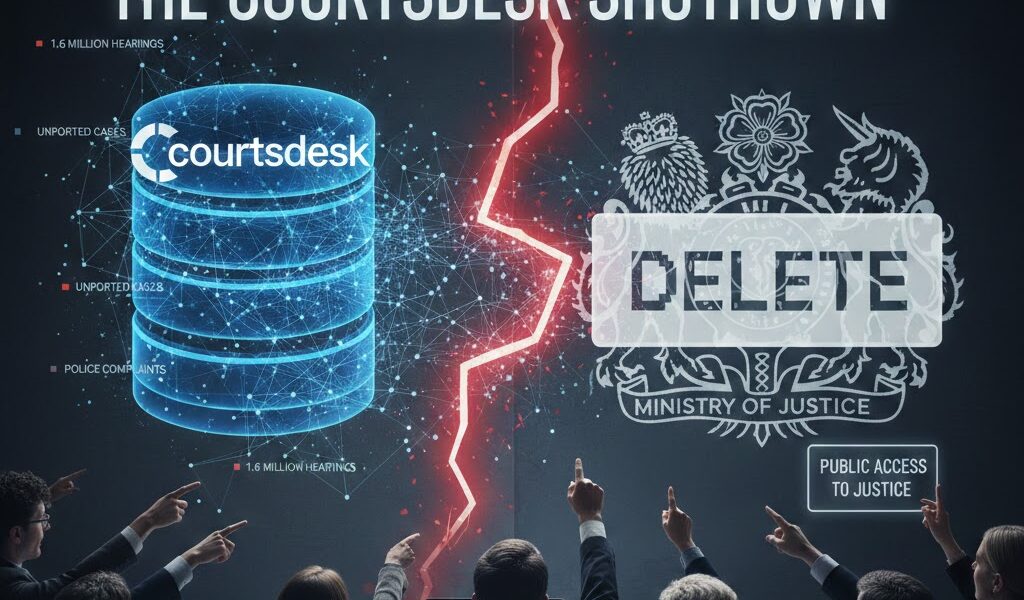
The Courtsdesk Shutdown: Why the MoJ is Deleting the UK’s Largest Court Archive
The legal community is currently reeling from the Courtsdesk shutdown UK journalists and legal researchers are now forced to navigate. In a move that has sent shockwaves through the tech world, the UK’s Ministry of Justice (MoJ) has issued a controversial order to delete what was widely considered the country’s most effective court reporting database. This unprecedented move, finalized in February 2026, has sparked a fierce “Open Justice” debate that pits government data security against the public’s right to information.
📊 MoJ vs. Courtsdesk: The Central Dispute
| Issue | Ministry of Justice (MoJ) Stance | Courtsdesk Defense |
| Reason for Deletion | Claims a “serious data breach” involving unauthorized sharing with an AI firm. | States they hired an AI firm for testing only under a strict non-disclosure agreement. |
| Data Privacy | Argues sensitive info (victim addresses/DOBs) was put at risk, violating GDPR. | Maintains data is automatically deleted every 24 hours; no permanent archive exists. |
| Agreement Status | Courts Minister Sarah Sackman claims Courtsdesk “accepted” they breached the contract. | CEO Enda Leahy denies ever admitting a breach; says they denied it in 16 separate letters. |
| Open Justice | States accredited journalists still have full access via traditional court listings. | Data shows official listings are accurate only 4.2% of the time, hiding 1.6m hearings. |
The AI Scandal: Why the MoJ Issued a Cessation Notice
At the heart of the Courtsdesk shutdown UK controversy is a “cessation notice” issued by the Ministry of Justice. Specifically, Courts Minister Sarah Sackman KC told the House of Commons in a February 2026 session of Hansard that Courtsdesk committed a “serious data breach” by sharing sensitive personal information—including victim addresses and dates of birth—with a third-party AI company.
Furthermore, the MoJ argues that this violated the original 2020 licensing agreement, which was designed strictly to help journalists navigate magistrate court records. Consequently, Sackman emphasized that the government must “center the dignity of victims” above commercial innovation.
The MoJ’s concerns over AI data handling reflect a growing global debate on model safety. While we’ve seen how advanced models like GPT-5.2 are solving physics puzzles, the Courtsdesk case highlights the legal risks when those same models are applied to sensitive personal records without clear regulatory guardrails.
1.6 Million Hearings Unreported? The Courtsdesk Defense
However, Courtsdesk CEO Enda Leahy, a veteran investigative journalist, has hit back at these claims. He maintains that the AI firm was hired specifically to test a new search feature and was legally barred from using or training models on the data.
Additionally, Leahy’s team released startling data regarding the state of official UK justice reporting. Their research highlights:
- The Accuracy Gap: Official court listings were accurate on only 4.2% of sitting days.
- Invisible Justice: Over 1.6 million criminal hearings took place with no advance notice provided to journalists.
- The Weekend Crisis: Half a million weekend cases were heard in near-total secrecy.
A Turning Point for Digital Justice
The National Union of Journalists (NUJ) and press freedom advocates warn that without Courtsdesk, reporting will return to the “dark ages.” In an official statement from the NUJ, General Secretary Laura Davison expressed concern that this deletion will fundamentally change the information available to the public. While the MoJ promises a government-run alternative by late March 2026, critics fear a state-controlled portal will lack the transparency that made Courtsdesk indispensable.
As the deletion deadline looms, the legal community is left wondering: Is this truly a win for data protection, or a convenient way for the government to hide the systemic failures of the UK courts? In light of the Courtsdesk shutdown UK reporters are now calling for a national strategy that balances innovation with public access.
What are your thoughts on this decision? Do you believe the benefits of public access to court information outweigh privacy concerns? Share your perspective in the comments below.