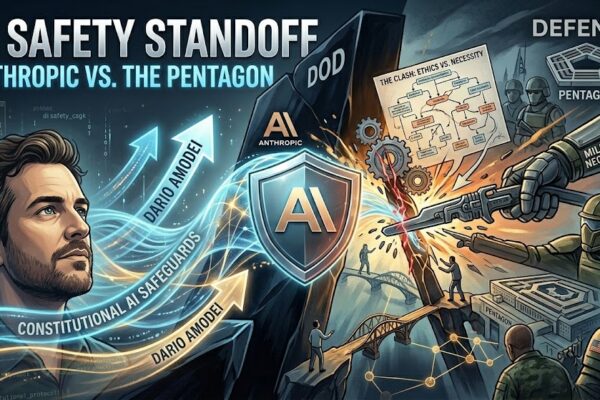

The artificial intelligence world is witnessing a historic rift. Dario Amodei, CEO of Anthropic, has publicly accused OpenAI of spreading “straight up lies” regarding their military partnerships. This confrontation between two of AI’s most influential leaders has sent shockwaves through the tech community, raising critical questions about transparency, national security, and the future of human-centered AI.
The Spark That Ignited the Controversy
The controversy erupted in early 2026 when OpenAI announced a massive expansion of its partnerships with the newly rebranded U.S. Department of War (DOW). While OpenAI claimed its systems would only be used for “defensive and humanitarian purposes,” Amodei’s explosive leaked memo suggests a much darker reality behind these public messages.
“What OpenAI is telling the public about their military involvement is simply not true,” Amodei stated in a leaked communication first reported by The Information. “They are painting a picture that doesn’t match the reality of their contracts and deployments.”
Understanding the Military AI Landscape
OpenAI’s Defense Partnerships: A $200 Million Shift
OpenAI has pivoted sharply toward government work since launching its “OpenAI for Government” initiative. Reports indicate the company has secured contracts with a $200 million ceiling, integrating GPT-class models into classified military networks. Key areas of collaboration include:
- Operational Planning: Generating strategic military options at scale.
- Intelligence Analysis: Summarizing classified data for field commanders.
- Cybersecurity Defense: Identifying and neutralizing CCP-sponsored cyber threats.
Anthropic’s “Red Lines” and the Pentagon Clash
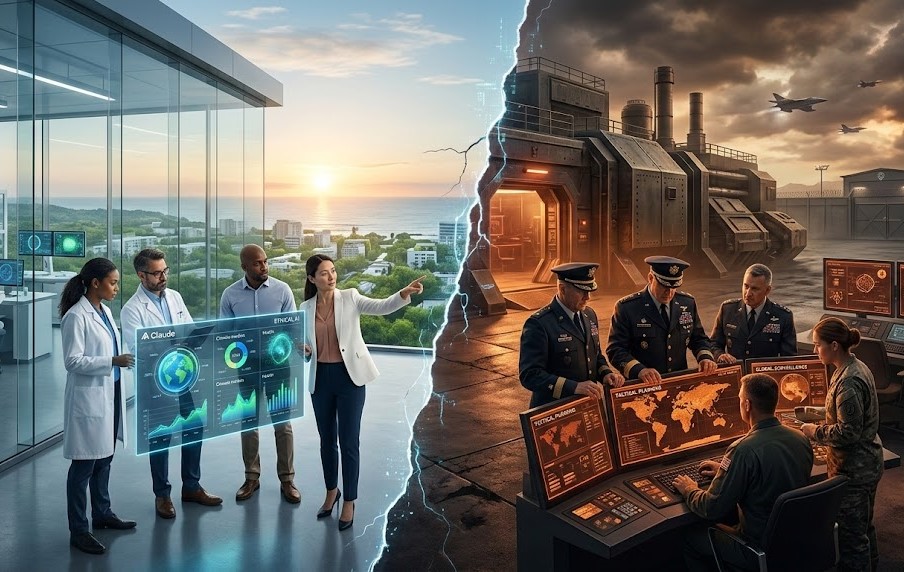
Anthropic, positioning itself as the ethical alternative, recently made headlines by refusing to remove safeguards requested by the Pentagon. Amodei has drawn two non-negotiable “red lines”:
- Mass Domestic Surveillance: Prohibiting Claude from being used to monitor U.S. citizens.
- Fully Autonomous Weapons: Refusing to allow AI to make lethal “life-or-death” decisions without human intervention.
This refusal led to a retaliatory move by the administration, which designated Anthropic as a “supply chain risk”—a label typically reserved for foreign adversaries.
The Truth Behind the “Defensive Purposes” Claim
Analyzing OpenAI’s Public Statements
OpenAI CEO Sam Altman has attempted to frame the company as a “peacemaker,” claiming their contract includes guardrails mirroring those of Anthropic. However, critics point to a significant loophole: the “any lawful use” clause. By agreeing to allow the military to use AI for any “lawful purpose,” OpenAI essentially defers ethics to current government policy, which can be changed at any time.
Expert Analysis of the “Legal Use” Loophole
Dr. Sarah Chen, an AI ethics researcher at Stanford, warns: “When a contract permits ‘any lawful use,’ the AI developer loses the ability to enforce ethical guardrails. If the government decides a certain type of surveillance is ‘lawful’ tomorrow, the AI company has already signed away its right to object.”
Industry Reactions and Global Implications
The Tech Community Response
The dispute has polarized Silicon Valley. Nearly 900 employees from Google and OpenAI recently signed an open letter supporting Anthropic’s stand, urging their own companies to reject demands for autonomous lethal operations.
Investor and Market Impact
The controversy has caused a tangible “trust deficit.” In the days following the announcement, data showed a 295% surge in ChatGPT Plus cancellations, with many users switching to Anthropic’s Claude as a “protest move” against military-integrated AI.
Looking Ahead: The Path Forward
Potential Resolutions
The resolution of this feud could take several forms:
- Congressional Investigation: Calls are growing for a probe into how the Pentagon handles AI contracts.
- The “Safety Theater” Debate: Industry experts are debating whether OpenAI’s “human-in-the-loop” promises are substantive or merely “safety theater” to pacify employees.
- International Standards: The clash may accelerate the adoption of frameworks like the EU AI Act as a global benchmark for high-risk AI.
Conclusion: A Critical Juncture for AI
The confrontation between Amodei and OpenAI represents a critical moment. It forces us to ask: Should private tech companies have the power to limit government use of their tools? Or should the government have unrestricted access to the most powerful technology ever created?
As 2026 unfolds, the decisions made in these boardrooms will define the role of AI in society for decades to come.
What are your thoughts on this controversy? Does OpenAI have a responsibility to restrict the military, or is Anthropic overstepping? Share your perspective in the comments below.