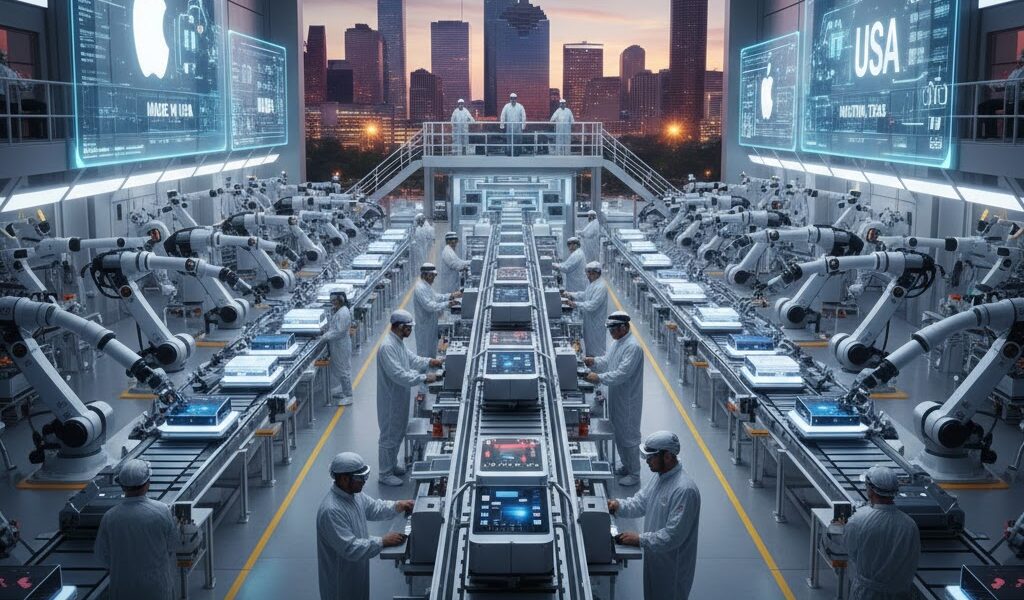
On 24 February 2026, Apple announced that the Mac mini would be made in the United States for the first time, at its facility in Houston, Texas. It’s a notable step for a company whose products have been assembled almost entirely in Asia for two decades. It’s also easy to overstate. This post sets out what Apple actually announced, what has happened since, and what it realistically changes.
What Apple announced
From Apple’s February 2026 newsroom post:
- Mac mini production in Houston will start later in 2026, the first time the Mac mini is built in the US.
- AI servers are already made there. Houston began producing advanced servers in 2025, ahead of schedule. These are the servers behind Apple Intelligence and Private Cloud Compute.
- Logic boards are produced on site.
- The campus footprint will roughly double with the new Mac mini factory, and Apple says the expansion will create thousands of jobs.
- A 20,000 sq ft Advanced Manufacturing Center was planned to open on the campus later in the year.
Tim Cook said Apple is “deeply committed to the future of American manufacturing,” and described Mac mini production as a significant expansion of its Houston footprint.
The announcement is part of Apple’s previously announced $600 billion US investment commitment. Apple also highlighted its US chip supply chain: it expects to buy more than 100 million advanced chips from TSMC’s Arizona plant in 2026, and it works with GlobalWafers’ $4 billion wafer facility in Sherman, Texas, and Amkor’s $7 billion packaging facility in Peoria, Arizona.
What has happened since
On 13 August 2026, Apple opened the Advanced Manufacturing Center. It offers free training, mainly for small and medium-sized businesses, with plans to expand to local college students. Courses cover final-assembly principles, circuit-board design for manufacturing, machine-learning-driven quality control and automation, with hands-on work on the production floor and virtual programming.
Apple said Houston will begin manufacturing Mac mini “this year,” meaning 2026. Apple also noted it had invested hundreds of millions of dollars in the facility in under nine months, and that its Detroit Manufacturing Academy, opened in August 2025, had already trained nearly 1,000 people.
What “Made in USA” means here
It’s worth being precise. A US-assembled Mac mini will still contain components from a global supply chain. The display-free Mac mini has fewer parts than most Apple products, but its chips, memory, storage and many smaller components come from facilities in several countries, even as more chip production moves to Arizona. “Made in Houston” means final assembly and logic board production happen in Texas, not that every part is American-made.
Apple hasn’t said what share of Mac minis sold in the US will come from Houston, so assumptions that “all US units” will be American-built go beyond what’s been announced.
Why the Mac mini?
Apple hasn’t explained the choice in detail, but a few factors make it a logical first candidate:
- It’s mechanically simple. No screen, keyboard or battery, and a compact enclosure with a relatively small bill of materials. That suits highly automated assembly.
- It’s related to the servers. Apple’s Houston servers use Apple silicon. Building desktop machines with similar components on the same campus can share expertise and supply lines.
- It has become popular for local AI. Developers increasingly use Mac minis as small, quiet machines for running local models, build servers and home labs. Demand is healthy and less seasonal than iPhone demand.
The AI server angle is the bigger story
For developers, the servers deserve more attention than the Mac mini. Private Cloud Compute is Apple’s system for running larger AI models in the cloud while trying to keep the same privacy promises as on-device processing. Apple has said the servers run Apple silicon, don’t keep user data, and use software images published for independent security researchers to inspect.
Building those servers in the US gives Apple more control over a critical part of its AI infrastructure, and Apple says production began ahead of schedule. If you build apps that use Apple Intelligence features, the capacity and reliability of that server fleet directly affects your users’ experience.
Will it change prices?
Apple hasn’t said, and it’s best to be sceptical of predictions either way. US assembly generally costs more in labour but can reduce shipping costs and exposure to tariffs and trade disruption. How those balance out, and whether any difference reaches customers, depends on trade policy and Apple’s pricing decisions. Nothing in Apple’s announcements commits to a price change.
What it means for developers and buyers
- Supply resilience: a second production location can reduce the risk of long shortages. That matters if you buy Mac minis in bulk for build farms or offices.
- Nothing changes in the hardware itself. A Mac mini from Houston should be the same product as one assembled elsewhere, with the same chips, specs and software.
- Training opportunities: if you’re a small manufacturer or a student in the Houston area, the free Advanced Manufacturing Center courses are a genuinely useful resource.
The bigger picture
Apple’s Houston expansion is a real but incremental change. One product line and a server fleet are moving to US assembly, backed by a growing domestic chip supply chain. It won’t reshape where most Apple products are made anytime soon. But it shows which products Apple thinks can be built in the US first: simple, high-value hardware closely tied to its AI infrastructure. That’s a reasonable signal of where the next steps might come from.
Questions still open
Several things Apple hasn’t announced are worth watching over the coming months:
- Volume. Apple hasn’t said how many Mac minis Houston will produce, or what share of US sales they’ll cover. The first production figures, if Apple shares them, will show whether this is a pilot line or a main source of supply.
- Which configurations. It isn’t clear whether every Mac mini configuration will be built in Houston or only some of them.
- What comes next. If Mac mini production goes well, the natural question is whether other compact products follow. Apple hasn’t committed to any.
- How it’s labelled. Buyers who care about origin will want to know how to tell a Houston-built unit apart. Apple hasn’t described any labelling.
Until Apple says more, the safest reading is the one in its own announcements: a real new production line for one product, alongside AI server manufacturing, with details still to come.
Related reading
- ThinkPad T14 Gen 7 and T16 Gen 5 Score 10/10 on iFixit
- Tech Layoffs in 2026: What the Numbers Actually Show
- Claude’s 1M Token Context: What It Costs and How to Use It
Sources: Apple Newsroom, February 2026, Apple Newsroom, August 2026, Houston Public Media.