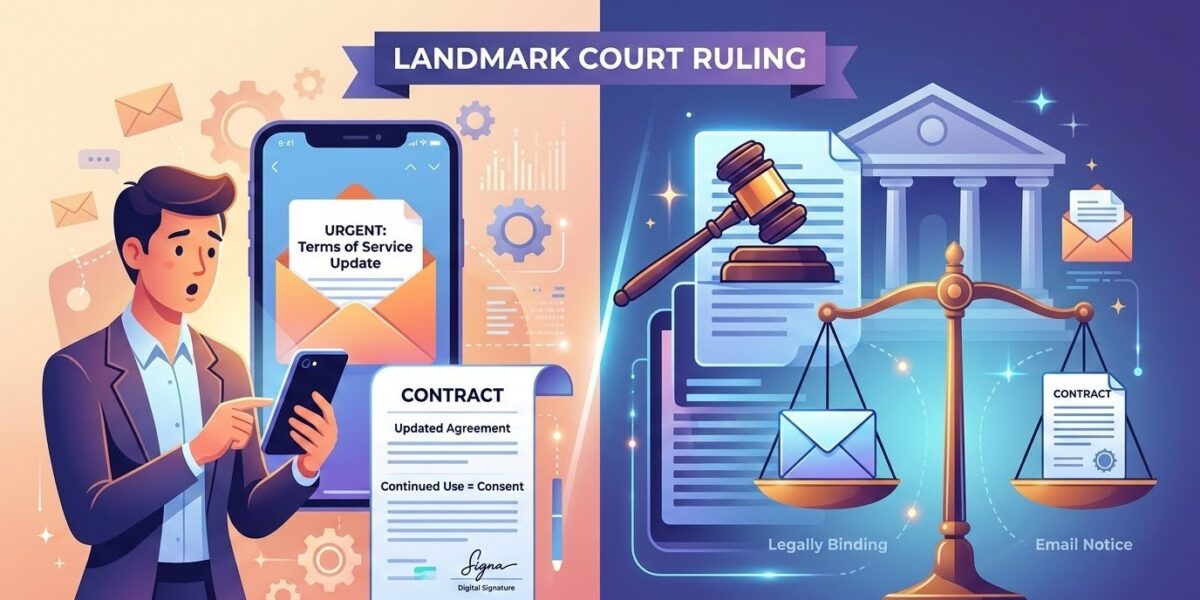
Key Takeaway: A recent US Court of Appeals decision establishes that companies can legally modify Terms of Service (TOS) via email. If you receive the email and continue using the service, you have legally “consented” to the new terms—even if you never clicked “I Agree.”
The legal landscape of digital agreements just shifted dramatically. A landmark US Court of Appeals decision has established that companies can update their Terms of Service (TOS) through email notifications, and continued use of a service constitutes legal consent. This ruling has significant implications for both businesses and consumers in our increasingly digital world.
The Shift: Why Continued Use Equals Consent
The case centered on whether electronic notifications via email could satisfy legal requirements for contract modifications. The court’s decision affirms that when users continue using a service after receiving TOS updates by email, they implicitly agree to the new terms. This interpretation aligns with how most digital services operate today, where users rarely read lengthy legal documents but continue using services regardless.
The Court’s Reasoning: The Doctrine of Constructive Notice
The appeals court based its decision on established contract law principles, specifically the doctrine of constructive notice. When companies provide reasonable notice of changes and users continue their engagement, courts view this as acceptance of modified terms. The ruling emphasized that email notifications represent a practical and efficient method for communicating updates to millions of users simultaneously.
Legal experts note this decision reinforces the concept that online behavior can constitute binding agreements. The court found that email notifications, combined with continued service usage, create a sufficient “paper trail” for contract modifications. This approach balances business needs for flexibility with consumer protection, provided the notice is “clear and conspicuous.”
Impact on Digital Service Providers
For businesses operating digital platforms, this ruling provides much-needed clarity. Companies can now confidently use email notifications to communicate TOS changes without fearing legal challenges based on the notification method alone. This streamlined approach reduces administrative overhead and allows businesses to adapt to evolving legal requirements efficiently.
However, the decision doesn’t give companies unlimited power. The court emphasized that notifications must:
- Be clear and conspicuous (not buried in a newsletter).
- Provide users a reasonable opportunity to review changes.
- Use clear subject lines that signal a legal update.
4 Things Consumers Need to Know
Consumers should be aware that ignoring TOS update emails may have legal consequences. Continued use of a service after receiving notification can bind you to new terms, even if you never opened the message. To stay protected, consider these steps:
- Review the Subject Line: Look for keywords like “Update,” “Terms,” or “Legal” in your inbox.
- Document Disagreements: If you disagree with new terms, the only legal way to “opt-out” is often to discontinue the service entirely.
- Check for Summary Links: Many companies now provide a “What’s Changed” summary; read this first to save time.
- Maintain Awareness: Understand that your digital engagement—simply logging in—carries contractual weight.
Best Practices for Business Compliance
To ensure these updates hold up in court, businesses should move beyond the bare minimum. A layered notification system is the new gold standard for E-E-A-T (Experience, Expertise, Authoritativeness, and Trustworthiness).
| Strategy | Implementation |
|---|---|
| Advance Notice | Send notifications at least 30 days before changes take effect. |
| Language | Use plain, non-technical English to explain changes. |
| Transparency | Provide a “Side-by-Side” comparison of the old vs. new terms. |
| Record Keeping | Maintain detailed logs of notification delivery and user login timestamps. |
The Broader Context of Digital Consent
This ruling fits into a larger conversation about digital autonomy. As services become integrated into daily life, the mechanisms for obtaining consent grow more complex. While email notifications are efficient, they raise questions about the true nature of “informed consent” if users are conditioned to ignore their inboxes.
Organizations should audit their current TOS update procedures and identify areas for improvement. Robust logging and analytics can provide the evidence needed to demonstrate compliance if legal disputes arise. As US companies often set the standard for international tech practices, we may see similar judicial approaches adopted globally in the near future.
Final Verdict: The US Court of Appeals has validated the reality of the modern web. Those “boring” legal emails matter more than ever. Read them carefully, or be prepared for the legal consequences of your continued use.