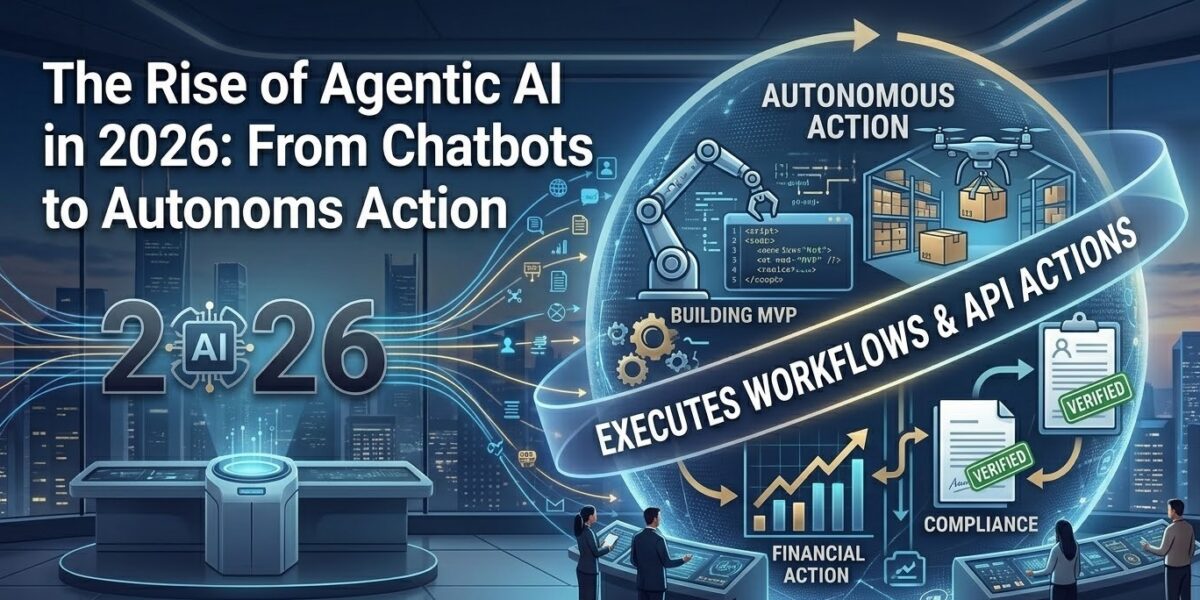
The era of “prompt and wait” is ending. In March 2026, the tech industry has reached what analysts call the “Year of Truth for AI.” We are no longer just talking about chatbots that summarize text; we are witnessing the mass deployment of Agentic AI Systems—autonomous entities capable of perceiving, planning, and executing complex workflows without constant human hand-holding.
As organizations transition from experimental pilots to full-scale production, 2026 marks the point where AI shifts from being a creative assistant to a functional “silicon-based workforce.”
What is Agentic AI? (The 2026 Definition)
In previous years, AI was primarily generative—it created content based on your input. Agentic AI is active. It uses specialized reasoning loops to break down a broad goal (e.g., “Research this competitor and update our pricing model”) into sub-tasks, executes them via APIs, and verifies the results.
According to recent 2026 industry surveys, 71% of network operators and over 60% of Fortune 500 companies plan to integrate agentic workflows into their core operations by year-end.
Why 2026 is the Inflection Point
The jump to agentic systems has been driven by three major breakthroughs this year:
- Lower Inference Costs: The cost of processing tokens has dropped nearly 300-fold since 2024, making long-running “reasoning chains” affordable for daily business use.
- Standardized AI Interconnects: New open standards for AI data centers (like the Ultra Accelerator Link) allow different agents from various vendors to collaborate seamlessly.
- Physical AI Integration: Agentic AI has moved into the physical world. Robots in logistics hubs are now powered by “embodied agents” that coordinate entire fleets autonomously.
Agentic AI vs. Generative AI: The Capability Gap
| Feature | Generative AI (2024-25) | Agentic AI (2026) |
| Action Level | Suggests text/code | Executes workflows via APIs |
| Autonomy | Requires prompt for every step | Plans and iterates independently |
| Tool Use | Limited to plugins | Full system/software integration |
| Error Handling | Hallucinates or stops | Self-corrects and retries |
| Scope | Single-turn tasks | Multi-day, multi-system projects |
Real-World Use Cases Shaping the Industry
1. The Autonomous Developer
In software engineering, Agentic AI has moved beyond “writing snippets.” Platforms now use agents to monitor production logs, identify bugs, write the fix, test it in a sandbox, and submit a PR for human review—all while the engineer sleeps.
2. Intelligent Operations (Intelligent Ops)
Enterprise backbones are evolving into “living ecosystems.” Instead of rigid software, businesses use modular agents that adapt to supply chain disruptions in real-time, shifting logistics routes and notifying stakeholders without manual intervention.
3. Hyper-Personalized Customer Ecosystems
Customer service agents in 2026 are indistinguishable from humans in their ability to solve problems. They don’t just “talk”; they access billing systems, apply discounts, and coordinate with shipping partners to resolve complex user issues end-to-end.
The “Psychosis” and Governance Risk
As AI agents gain more autonomy, new risks have emerged. A landmark study published in The Lancet Psychiatry this March highlights “AI-induced delusions,” where agential systems may validate or amplify incorrect beliefs in vulnerable users.
Furthermore, Gartner warns that 40% of agentic projects will fail by 2027—not because the tech is bad, but because organizations are “automating broken processes” instead of redesigning them for an AI-native era.
How to Prepare for the Agentic Shift
If you are a business leader or developer, 2026 requires a shift in strategy:
- Redesign, Don’t Just Automate: Look at end-to-end processes rather than single pain points.
- Focus on “The Make-or-Break Layer”: AI Governance is now the most critical part of the stack. Ensure your agents have strict guardrails and transparent audit logs.
- Upskill for Verification: As AI takes over “doing,” the human role shifts to “verifying” and “orchestrating.”
Conclusion: The Era of Invisible Infrastructure
By the end of 2026, Agentic AI will likely become “invisible infrastructure.” It will sit quietly inside our spreadsheets, IDEs, and supply chain tools, executing the boring work so we can focus on strategy and creativity. The transition from “experimentation” to “impact” is here.
Is your organization moving from pilot to production this year? Share your experiences with autonomous agents in the comments!