

The Hidden Crisis Behind Tech Company Growth
In the high-speed world of software and innovation, growth is usually seen as the ultimate goal. However, tech companies are facing an unexpected challenge that’s disrupting their operations: sizing chaos. As organizations scale rapidly, they’re discovering that what worked for a team of 50 employees often completely breaks down by the time they reach 500.
The term “sizing chaos” refers to the organizational turbulence that occurs when companies expand faster than their internal systems can adapt. According to data from Harvard Business Review, nearly 67% of tech startups report significant operational disruptions during their scaling phase, with most experiencing multiple “growth crises” before reaching stability.
Why Traditional Scaling Models Are Failing in 2026
Traditional business models were designed for manufacturing, not for the fluid nature of tech. Today, the rapid pace of change, remote work adoption, and global competition have created a perfect storm. Many organizations find that their productivity actually decreases as they grow—a phenomenon known as the “Scaling Paradox.”
The Three Critical Breaking Points of Growth
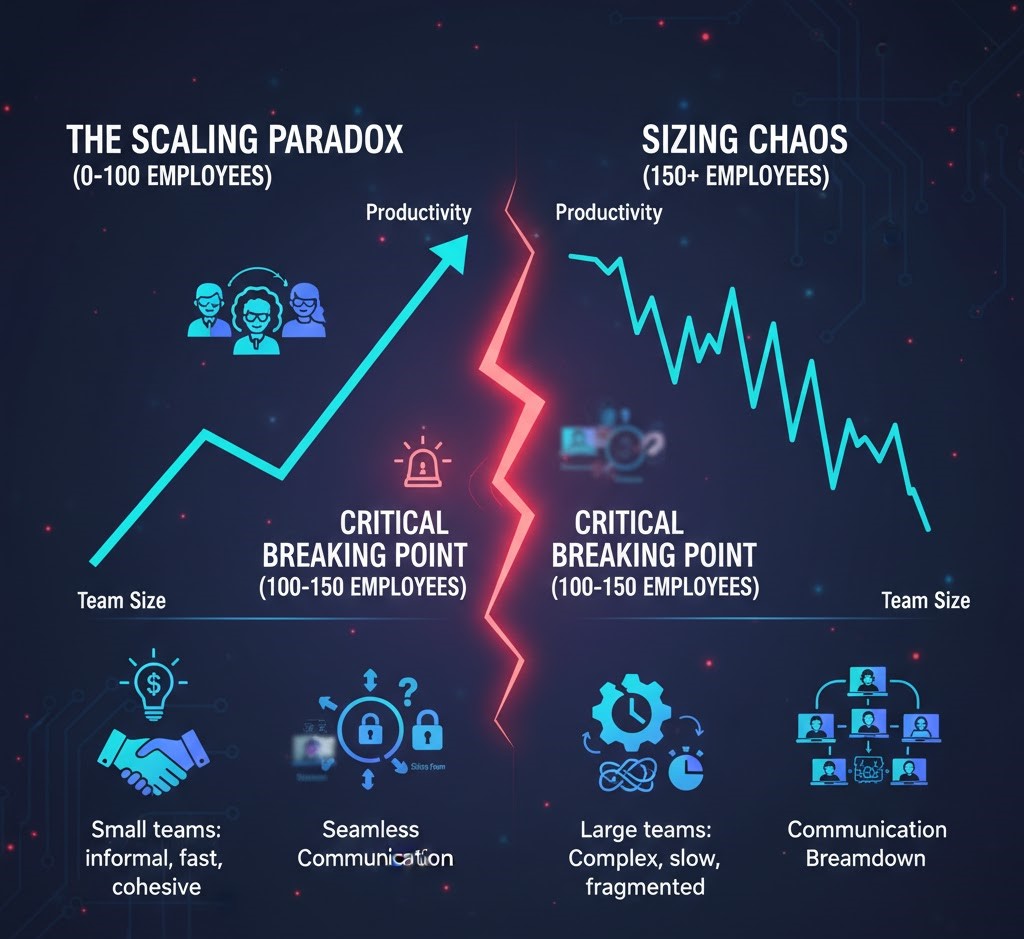
Industry experts have identified three specific team sizes where sizing chaos in tech companies typically emerges. Understanding these thresholds is the first step toward a solution:
| Team Size | The Primary Challenge | The Symptom |
| 25–50 Employees | Communication Collapse | Informal processes stop working |
| 100–150 Employees | Departmental Silos | Information bottlenecks and tribalism |
| 500+ Employees | Cultural Fragmentation | Teams operate under conflicting assumptions |
How to Solve Sizing Chaos: 4 Scalable Strategies
Successfully navigating growth requires treating your organization like a product. I believe that the right infrastructure—both digital and human—is the only way to sustain momentum. Here are four strategies that actually work:
- Intentional Organizational Design: Don’t let growth happen organically. Design your structure around your product’s specific needs.
- Communication Architecture: Implement formal protocols (like asynchronous documentation) that scale regardless of team size.
- Cultural Preservation Mechanisms: Create systems to maintain core values even as the team doubles in size.
- Technology Stack Modernization: Regularly evaluate your internal tools. A CRM or project management tool that worked for 10 people will likely fail at 100.
The Remote Work Complication
The shift to hybrid models has accelerated sizing chaos. Research suggests that remote teams require 40% more structured communication than co-located teams. Without clear digital workflows, information gets lost in the “void” of Slack messages and unrecorded Zoom calls.
The Future of Scaling: AI and Modular Design
As we look toward the future, new models are emerging. AI-powered organizational tools and decentralized team structures are helping companies grow 10x without the traditional friction. By embracing modular company designs, businesses can plug in new departments like “micro-services” rather than overhauling the entire machine.
Conclusion: Building a Resilient Organization
Sizing chaos in tech companies is a sign of success, but only if managed correctly. Awareness of these breaking points is the first step toward building a resilient, adaptable organization that can grow without breaking.
