The New Era of AI in Scientific Discovery
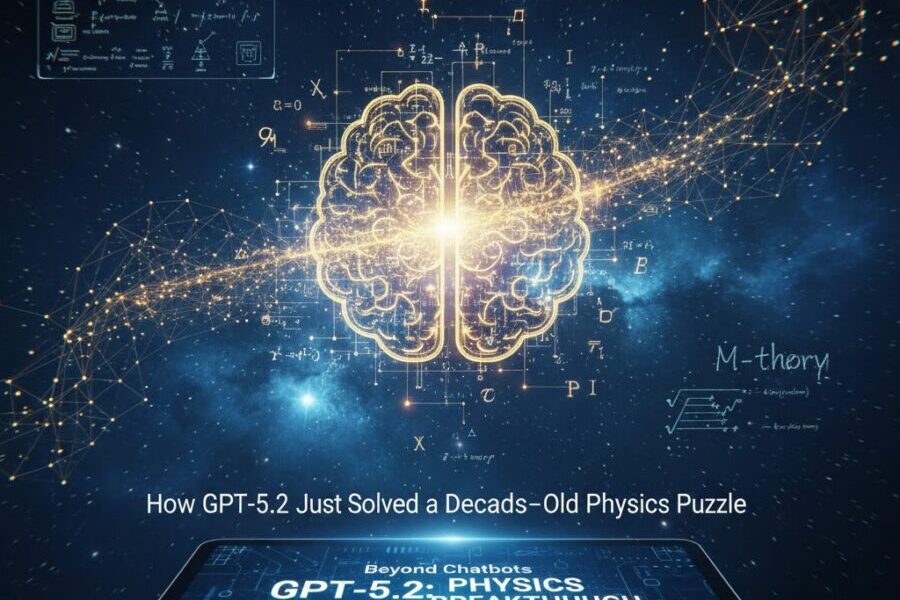
When we think about artificial intelligence, most people imagine chatbots or content creation. But on February 13, 2026, the boundary between “AI tool” and “AI scientist” officially blurred. OpenAI released a groundbreaking preprint demonstrating that GPT-5.2 Pro has derived a new, non-zero result in theoretical physics—specifically regarding gluon tree amplitudes.
As someone who has followed AI development from the early days of GPT-3, seeing a model move from “summarizing papers” to “generating original peer-reviewed physics” is the shift we’ve all been waiting for. This isn’t just a faster calculator; it’s a new way of doing science.
What Did GPT-5.2 Actually Discover?
The physics community is buzzing because GPT-5.2 addressed a specific, technical assumption in quantum field theory. For years, physicists assumed certain particle interactions (gluon amplitudes) vanished under specific conditions.
The Technical Impact of the GPT-5.2 Physics Discovery:
-
The Problem: Calculating how gluons (the “glue” of the strong nuclear force) interact is superexponentially complex for humans.
-
The AI Insight: GPT-5.2 Pro simplified complex mathematical expressions that human researchers from institutions like Harvard and IAS had been grinding through by hand.
-
The Result: It identified a specific “half-collinear” regime where these amplitudes are not zero, spotting a pattern and proposing a formula valid for all n interactions.
My Take: What’s fascinating isn’t just that it found the answer, but that it used a “thinking” process (likely the internal reasoning loops we saw in earlier ‘o1’ models) to spend 12 hours verifying its own proof before presenting it to the human authors.
Why This Matters: The “Centaur Science” Model
This breakthrough represents the birth of “Centaur Science”—a collaboration where humans set the high-level vision and AI handles the grueling pattern matching and symbolic math that usually takes a lifetime to master.
Consider the traditional timeline:
-
Human Discovery: Decades of education → Years of research → One breakthrough.
-
AI-Enhanced Discovery: Human intuition + AI reasoning → Breakthroughs in weeks.
If AI can solve problems in particle physics, the “Holy Grail” of reconciling gravity with quantum mechanics might actually be on the horizon.
Is This the End of the Human Scientist?
Hardly. The researchers involved (including legends like Nima Arkani-Hamed) noted that the AI still requires expert validation. While GPT-5.2 can propose a formula, a human must still interpret what that formula means for our understanding of the universe.
However, for technology professionals, the message is clear: AI Literacy is the new English. If you aren’t learning how to “prompt” or “collaborate” with reasoning models like GPT-5.2 or Gemini 3 Deep Think, you’re essentially trying to do math without a calculator in the 1970s.
Challenges: The “Black Box” Problem
Despite the victory, we still face the Explainability Gap. GPT-5.2 can show us the math is right, but it can’t always explain the “Aha!” moment in a way that helps a human student learn the same intuition. As we move forward, making AI “explainable” will be just as important as making it “smart.”
Conclusion: A New Era Post-GPT-5.2 Physics Discovery
GPT-5.2’s breakthrough in gluon amplitudes isn’t just a win for physics; it’s a proof of concept for every industry. From drug discovery to climate modeling, we are entering a golden age where the bottleneck is no longer our processing power, but our curiosity.
What are your thoughts? Are you ready to treat an AI as a “co-author” in your work, or does the idea of “autonomous discovery” feel a step too far? Share your perspectives in the comments below.