
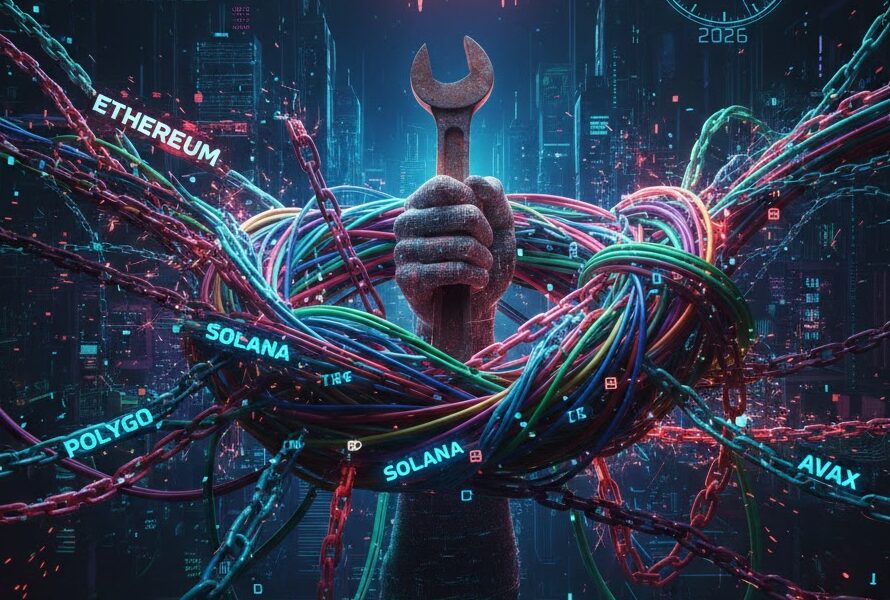
Building in the “multi-chain” era was supposed to be seamless by now, yet for many of us, cross-chain API integration has become a fragmented nightmare. We were promised an “Internet of Value” where chains talk to each other as easily as legacy servers, but the reality of 2026 feels like a step backward.
If you’ve spent your recent weekends wrestling with 15 different SDKs just to move a stablecoin without losing your mind to slippage, you’re not failing—the infrastructure is. I’ve reached the stage where I’m no longer interested in building custom bridges from scratch; I’m looking for middleware that actually works.
The “Simple” Project Trap
It starts innocently enough. You decide to build a straightforward portfolio tracker with a built-in swap UI. Maybe you want to sharpen your Rust skills or dive deeper into DeFi protocols.
But then, reality hits. To support even basic cross-chain API integration (say, Ethereum to Solana), you realize you’re suddenly juggling:
- 15+ different SDKs that don’t like talking to each other.
- Rapidly decaying documentation where “stable” versions from last month are already deprecated.
- AI hallucinations, where LLMs confidently suggest code for endpoints that no longer exist.

The Reality of Cross-Chain API Integration Today
The irony of 2026 is that while we have more “solutions” than ever, the cognitive load for developers has skyrocketed. When you’re trying to prevent 5% slippage on a bridge, interacting with raw contracts directly becomes a full-time job of maintenance and monitoring.
For most independent devs and small teams, the “purist” route of running your own nodes and writing custom bridge logic is becoming a luxury of the past. The time spent debugging a custom Rust bridge often outweighs the benefits of “total control.”
Is It Time to Capitulate to Aggregators?
When the “dirty work” of liquidity routing and chain-specific quirks becomes too much, the industry shifts toward middleware.
I recently started digging into the heavy hitters like 1inch and ParaSwap, but I’ve also been looking at the LetsExchange API. When you compare the time spent debugging a custom integration versus the plug-and-play nature of a clean exchange widget, the “easy way” starts looking very attractive. Their documentation actually stays updated, which is a rare win in this ecosystem.
Custom Development vs. Aggregator APIs
If you’re still on the fence about whether to build your own bridge or use an existing solution, here is how the two paths stack up:
| Feature | Custom Smart Contract Integration | Aggregator API (e.g., LetsExchange) |
| Development Time | Weeks/Months | Hours/Days |
| Maintenance | High (Updates with every fork) | Low (Handled by provider) |
| Slippage Control | Manual Routing | Automated Best-Rate Routing |
| Security Risk | You manage private keys/logic | Managed by audited infrastructure |
| User Experience | Technical & Rigid | Clean, Widget-based UI |
The Developer’s Dilemma: Build vs. Buy
This brings us to a crossroads. We have two distinct paths:
- The Purist Path: Running your own nodes, interacting directly with smart contracts, and maintaining total sovereignty (at the cost of your sanity).
- The Aggregator Path: Using third-party APIs and middleware to handle the plumbing so you can focus on the actual UI/UX.
What’s your take? Are you still grinding away at custom integrations to keep your dApp decentralized, or have you fully embraced the “Aggregator Era” to save your weekends?
Let’s discuss in the comments.
Frequently Asked Questions (FAQ)
Q: Why is cross-chain API integration so difficult in 2026? A: The main issue is liquidity fragmentation. With hundreds of L2s and sidechains, maintaining a direct cross-chain API integration requires constant updates to handle changing protocols and bridge security updates.
Q: Should I use Rust for building cross-chain tools? A: Rust is excellent for performance and safety in Web3. However, even with Rust, the “plumbing” of a cross-chain API integration can be overwhelming. Many developers now use Rust for core logic but rely on APIs for the actual swapping and bridging.
Q: Are crypto aggregators decentralized? A: It depends on the provider. Most aggregators source liquidity from decentralized exchanges (DEXs), but the API itself is a centralized gateway. For many dApp builders, this is an acceptable trade-off for the massive gain in reliability.
