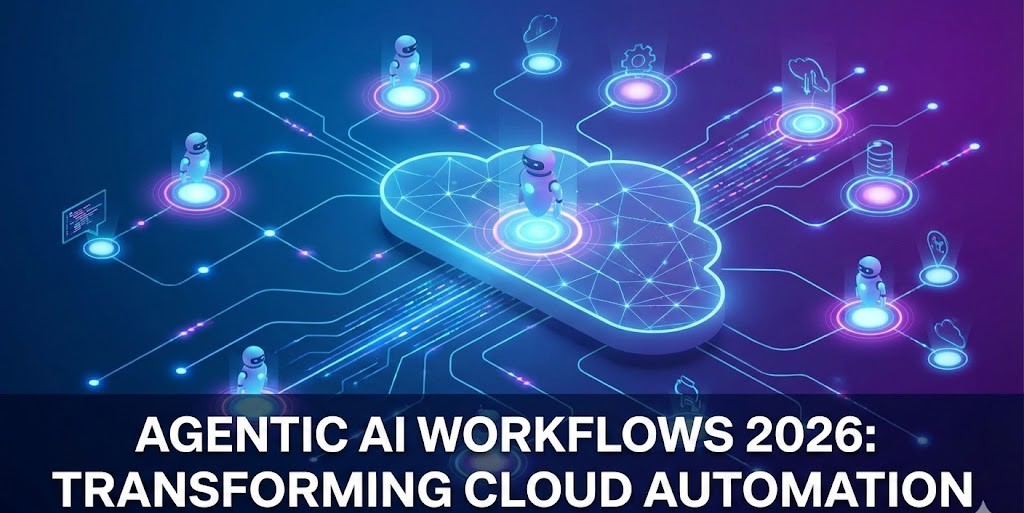
In the rapidly evolving tech landscape, Agentic AI workflows 2026 have become the gold standard for business automation. While 2024 was the year of the chatbot, 2026 is officially the year of the “Agent.” We are moving away from AI that simply answers questions and toward systems that execute complex tasks autonomously on your private cloud infrastructure.
What are Agentic AI Workflows?
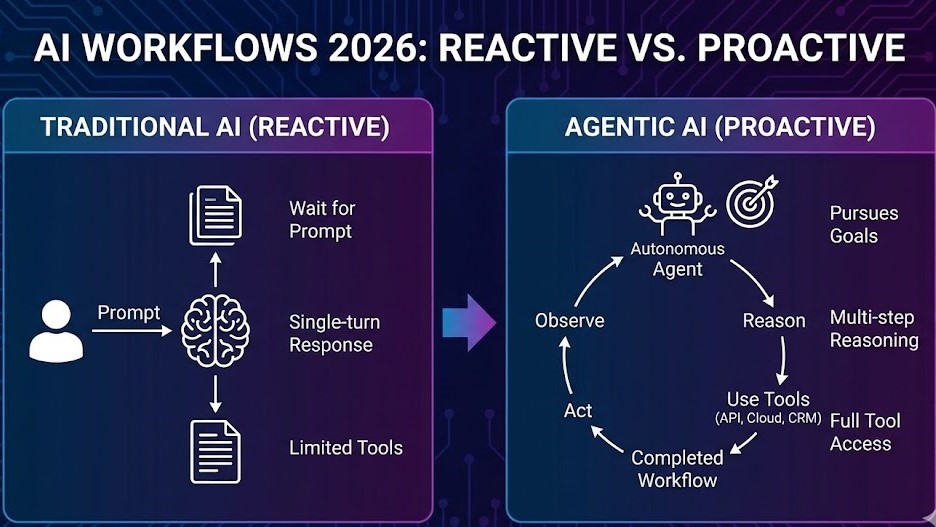
Agentic AI workflows refer to autonomous systems that can reason, use external tools, and complete multi-step tasks without constant human prompting. Unlike a standard Large Language Model (LLM) that waits for a prompt, an AI Agent can observe a problem, decide on a goal, and use software APIs to finish the job independently.
The “Doing” Era: Why Agents Beat Chatbots
For the past few years, we’ve treated AI like a smart encyclopedia. Today, the focus is on performance. By implementing Agentic AI workflows, companies are seeing a 40% increase in operational efficiency compared to traditional chatbots.
| Feature | Traditional Generative AI | Agentic AI |
| Interaction | Reactive (Wait for prompt) | Proactive (Pursues goals) |
| Logic | Single-turn response | Multi-step reasoning loops |
| Tool Use | Limited (Plugins) | Full (Access to APIs, CRM, Cloud) |
| Outcome | Text/Images | Completed Workflows |
Why Sovereign AI is Essential
As Agentic AI workflows become more powerful, they handle increasingly sensitive data. This is where Sovereign AI comes in. Instead of sending data to public “black box” models, savvy enterprises are deploying their own agentic frameworks on private cloud infrastructure.
Hosting your own agents ensures:
- Data Privacy: Your proprietary workflows never leave your cloud perimeter.
- Latency: Faster execution for real-time autonomous tasks.
- Cost Control: Avoiding “per-token” fees by using open-weight models like Meta’s Llama 4.
Top 3 Frameworks for Agentic AI Workflows
If you are looking to build or deploy Agentic AI workflows on your cloud this month, these are the leading libraries:
1. LangGraph (The Orchestrator)
LangGraph allows you to create “cycles” in your AI logic, enabling agents to fix their own errors before delivering the final result.
2. CrewAI (The Multi-Agent Team)
CrewAI lets you assign roles—like a “Researcher” and a “Writer”—who collaborate to produce high-quality output automatically.
3. Agno (High-Performance Runtime)
Agno is a lightweight runtime designed specifically for scaling Agentic AI workflows 2026 across massive cloud instances.
How to Start with Agentic AI Workflows Today
You don’t need a PhD to start. Here is your 2026 roadmap:
- Identify a Workflow: Find a multi-step task like lead research or invoice processing.
- Define the Tools: Give the AI access to Gmail, Slack, or your internal SQL database.
- Set Guardrails: Use “Bounded Autonomy” so the AI proposes a solution but waits for human approval.
- Deploy on Your Cloud: Secure your data by hosting locally on your cloud environment.
Ready to deploy your first agent? The future of the cloud isn’t just storage; it’s intelligence. Embrace Agentic AI workflows to stay ahead of the competition.