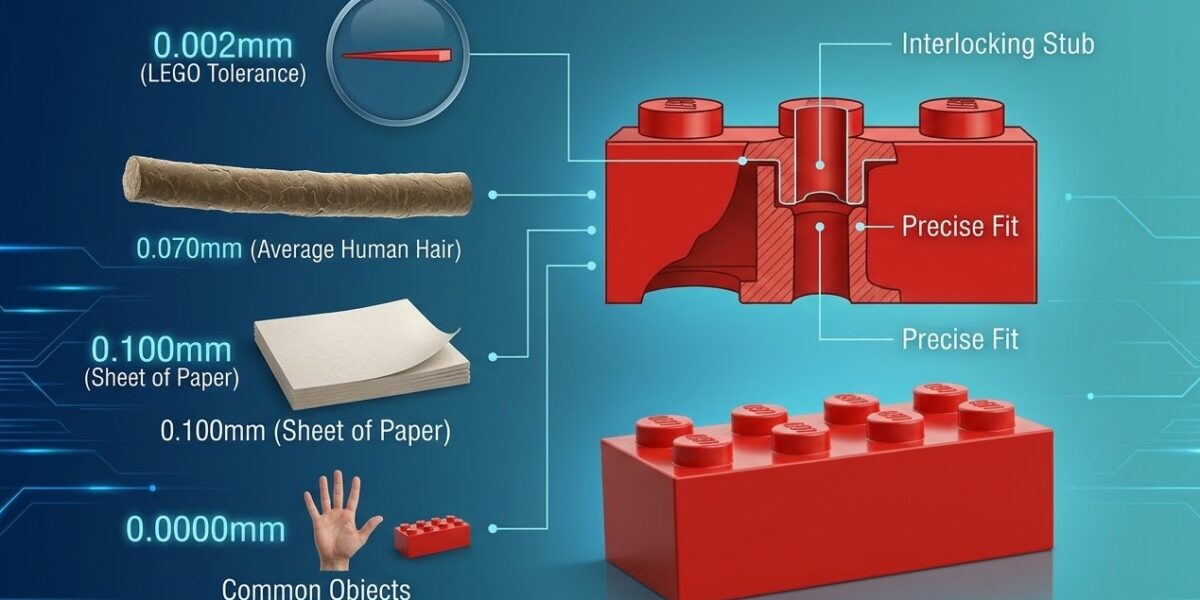
Executive Summary: Lego maintains a microscopic manufacturing tolerance of 0.002mm (1/50th of a human hair). This legendary precision ensures that every brick made since 1958 fits perfectly, setting a “Gold Standard” now being adopted by the aerospace, medical, and automotive sectors.
When you think of Lego bricks, you likely imagine colorful toys. But beneath this simple concept lies one of the most remarkable engineering achievements in history. Lego’s 0.002mm specification represents a level of precision that most industries can only dream about.
In 2026, this microscopic tolerance is becoming a benchmark that’s reshaping how manufacturers think about quality. The implications extend far beyond the toy chest, influencing everything from aerospace components to life-saving medical devices.
The Science of Microscopic Precision
Lego’s manufacturing process achieves the near-impossible: producing over 5,000 different shapes with a 0.002mm tolerance. To visualize this, consider how Lego compares to other common objects:
| Object / Standard | Approximate Thickness/Tolerance |
|---|---|
| Standard Sheet of Paper | 0.100 mm |
| Average Human Hair | 0.070 mm |
| High-End CNC Machining | 0.010 mm |
| Lego Brick Tolerance | 0.002 mm |
Maintaining Standards at Scale
Maintaining such tight tolerances across millions of units requires extraordinary environmental control. Lego’s factories operate under strict climate regulation, as even minor temperature shifts can cause plastic to expand or contract beyond the allowed 0.002mm limit.
The company utilizes Computer-Aided Manufacturing (CAM) and proprietary injection molding technology to detect variations smaller than the human eye can see. This commitment ensures that a brick manufactured in 1970 still snaps perfectly onto a piece made in 2026.
Industrial Adoption: Beyond the Toy Box
The “Lego Method” is now a blueprint for several critical sectors:
- Automotive: Manufacturers are implementing Lego-style quality gates to reduce assembly friction and mechanical failure.
- Medical Devices: Precision is vital for surgical implants where a fraction of a millimeter can affect patient outcomes.
- Aerospace: Reducing “slop” in mechanical linkages through ultra-tight tolerances improves fuel efficiency and safety.
The Economic and Environmental Impact
While the initial investment in high-precision equipment is steep, the long-term ROI is significant. High precision leads to less material waste and fewer defective batches. In fact, Lego’s high-precision approach results in less than 1% waste in their production cycle—a figure most manufacturers strive to emulate.
Challenges: The Cost of Perfection
Despite the benefits, 0.002mm manufacturing isn’t always necessary. Manufacturers must weigh the cost-to-benefit ratio. For many consumer goods, such tight tolerances offer diminishing returns. However, as measurement technology becomes more accessible, we are seeing a democratization of precision that allows smaller shops to compete with global giants.
Conclusion: The Legacy of Precision
Lego’s 0.002mm specification has established a new standard for manufacturing excellence. It proves that consistency and quality control are not just “nice to have”—they are the pillars of a world-class brand. As we look toward the future of Industry 4.0, the lessons learned from a simple plastic brick will continue to guide the next generation of engineers.
What do you think about the future of precision manufacturing? Share your thoughts in the comments below!