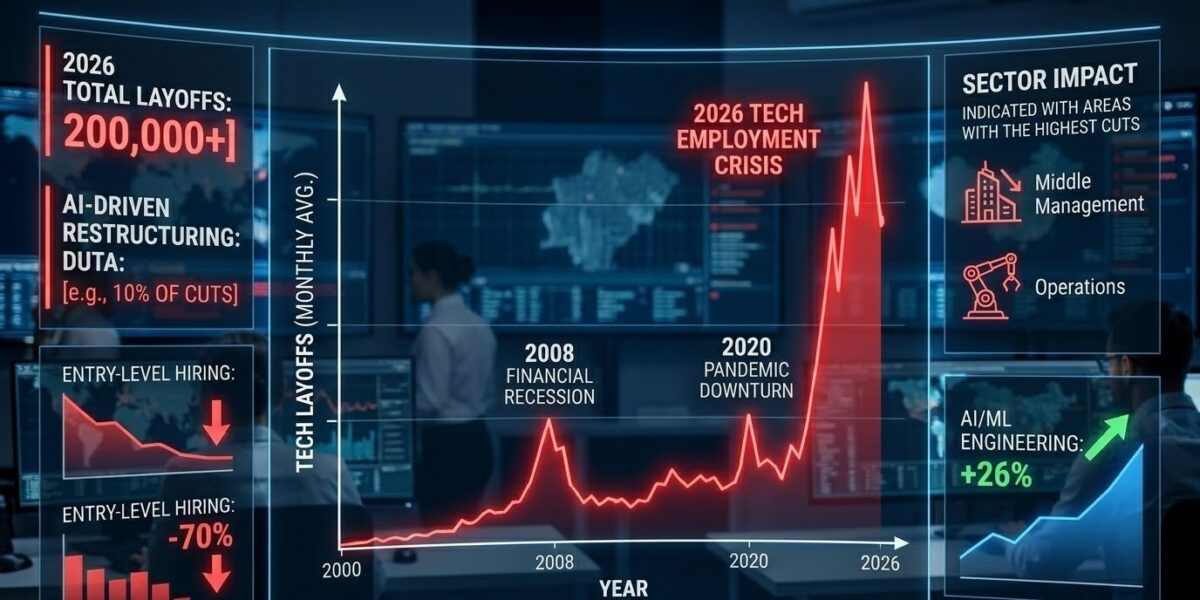
The technology sector, once the gold standard for job security, is currently facing a “structural recalibration” that many experts call the tech employment crisis 2026. Recent data from the Bureau of Labor Statistics and independent trackers like Layoffs.fyi show that job losses in early 2026 have already surpassed the monthly averages of the 2008 financial crisis.
In February 2026 alone, the U.S. economy shed 92,000 jobs, with the technology sector bearing a disproportionate share of that burden. Unlike the 2020 pandemic recession, which saw a quick “V-shaped” recovery, today’s crisis represents a fundamental shift in how corporations value human capital versus artificial intelligence.
Why This Crisis Outperforms Previous Tech Downturns
The tech employment crisis 2026 differs from past recessions because it is not just a result of high interest rates or inflation. Instead, three specific “perfect storm” factors drive this decline:
- The AI Transition: Companies are explicitly citing AI as the cause for layoffs. In early 2026, nearly 10% of announced cuts (including massive reductions at Block and Oracle) were attributed to AI-driven restructuring.
- The “Hiring AI” Strategy: Firms are freeing up capital by reducing headcount so they can afford the massive computing costs required for Generative AI.
- Entry-Level Collapse: Hiring for junior roles has plummeted by over 70% as automation replaces “stepping-stone” tasks like basic coding and data entry.
The Hardest-Hit Sectors in 2026
While the entire industry feels the pressure, certain sectors are at the epicenter of the tech employment crisis 2026:
Software Development and Engineering
The demand for generalist software engineers has shifted. While companies like Intel and Amazon recently cut tens of thousands of roles, they are simultaneously hiring specialized AI/ML engineers. According to LinkedIn data from February 2026, AI Engineer postings grew by 26%, while generalist Software Developer roles continued to shrink.
Operations and Middle Management
“Agentic AI”—systems capable of executing workflows without human oversight—is currently gutting operations teams. Salesforce and other CRM giants have shifted toward “agentic” services, leading to thousands of support and administrative job cuts.
Resilience Amidst the Downturn: Where the Jobs Are
Despite the severity of the tech employment crisis 2026, specific niches remain highly competitive and offer high-wage premiums.
| Role Category | 2026 Growth Trend | Key Skill Demand |
| Cybersecurity | +18.9% | AI-threat mitigation |
| AI/ML Engineering | +26.6% | Model fine-tuning, RAG |
| Data Infrastructure | +12.6% | Scalable cloud architecture |
Professionals who possess AI-related skills now command a 23% wage premium over their peers, proving that specialization is the only true defense against the current market volatility.
Expert Predictions: The Long Road to Recovery
When will the tech employment market recover? Industry analysts at Challenger, Gray & Christmas suggest that we are witnessing a permanent shift. They predict that while the total number of tech jobs may eventually return to 2021 levels, the types of roles will be unrecognizable.
For more real-time tracking of these trends, you can visit the official BLS Employment Situation Summary.
Strategies to Survive the Tech Employment Crisis 2026
To remain employable, you must treat your career as an evolving product. Consider these actionable steps:
- Master Human-AI Collaboration: Don’t fear being replaced by AI; fear being replaced by someone who uses AI better than you.
- Focus on Soft Skills: Complex decision-making and relationship management remain the hardest tasks to automate.
- Upskill into “AI-Proof” Areas: Cybersecurity and Cloud Architecture are currently the most resilient fields.
- Leverage Skills-Based Hiring: Over 70% of employers now prioritize demonstrable skills over degrees.
Final Verdict
The tech employment crisis 2026 is a painful but necessary evolution of the industry. While the “easy growth” era of the 2010s has ended, a new era of high-value, AI-augmented work is beginning. Those who adapt their skill sets today will be the leaders of the tech economy tomorrow.
What are your thoughts on the current tech employment situation? Have you noticed a shift in hiring at your company? Share your experiences in the comments below.