In March 2026, the future of version control is no longer just about tracking lines of code—it’s about managing a collaborative ecosystem of humans and autonomous AI agents. With GitHub now hosting over 420 million repositories, the scale of global collaboration has reached a tipping point that requires a fundamental rethink of our most basic tools.
The Evolution: Preparing for Git 3.0
As we move through 2026, the biggest shift in the landscape is the final groundwork for Git 3.0. This isn’t just a version bump; it’s a security and performance overhaul.
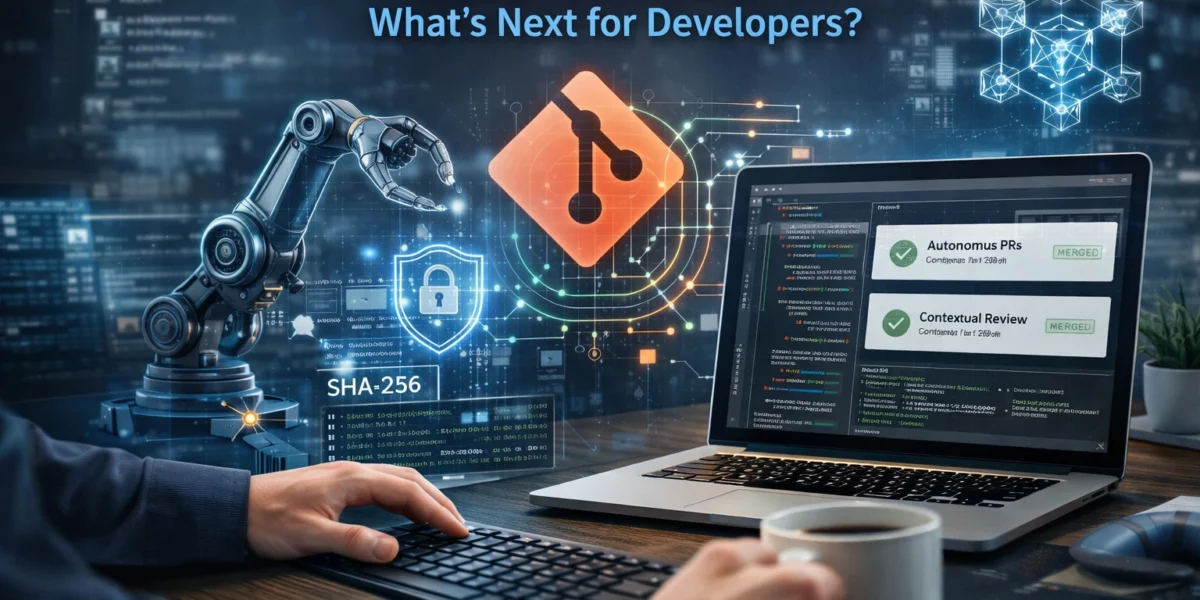
- SHA-256 by Default: Moving away from the aging SHA-1 algorithm, Git 3.0 prioritizes cryptographic integrity to protect against the rising “Glassworm” Unicode malware attacks hitting repos this year.
- Rust Integration: For the first time, Git is moving away from a pure-C codebase, integrating Rust for memory safety in its core ref-handling logic.
- Reftable Backend: A new storage format that makes
git fetchandgit pushup to 20x faster for massive monorepos.
Emerging Trends in the Future of Version Control
1. Agentic AI and “Self-Healing” Commits
The most visible change in 2026 is the rise of Agentic AI. Unlike simple autocomplete, these agents now function as “Digital Coworkers.”
- Autonomous PRs: Agents can now identify a bug in a production log, create a branch, write a fix, and submit a PR before a human developer even starts their morning coffee.
- Contextual Reviews: AI agents now understand the intent behind a change, providing code reviews that focus on architectural logic rather than just syntax.
2. Semantic Diffing
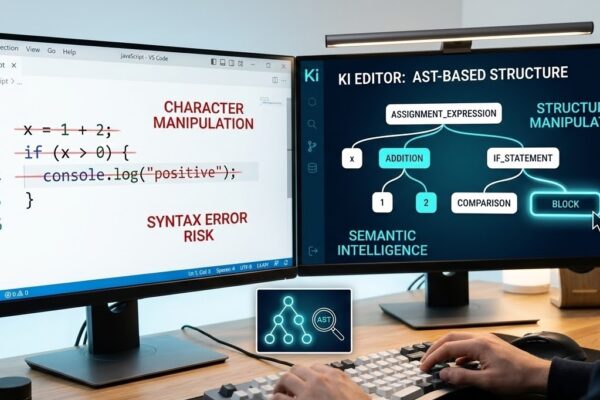
Traditional version control is “line-based,” which often leads to “merge hell” when two people move the same function to different files. Semantic Diffing understands the structure of the code. If you rename a variable or move a method, the VCS recognizes it as a structural change rather than a “deletion and addition,” making conflict resolution 90% faster.
3. Decentralized and “Glassworm-Proof” Security
With the March 2026 wave of supply chain attacks, security has become ambient.
- Governance-as-Code: Guardrails are now embedded directly into the repo DNA.
- Blockchain Anchoring: While full blockchain-VCS remains a niche, many enterprise teams now “anchor” critical release hashes to a decentralized ledger to ensure an immutable audit trail.
Challenges: Managing the “Noise”
As AI agents start contributing to repos, the volume of commits has exploded. The challenge for 2026 isn’t writing code; it’s filtering the signal from the noise.
- History Bloat: Teams are increasingly using “Ephemeral Branches” that disappear once merged to keep repo sizes manageable.
- The Human Supervisor Model: Developers are transitioning from “coders” to “managers of agents,” where the primary skill is reviewing AI-generated logic for edge-case safety.
Best Practices for 2026
To stay ahead of the future of version control trends, adopt these habits today:
- Adopt Atomic Commits: AI agents struggle with “kitchen sink” commits. Small, logical units of work are easier for both humans and AI to verify.
- Enable Signed Commits: In an age of AI-generated code, verifying that a human actually approved a change is critical for compliance.
- Learn the CLI: Even with sophisticated AI, understanding the underlying Git plumbing is what separates senior architects from prompt engineers.
Conclusion: A More Intelligent Core
The future of version control is bright, moving from a passive “filing cabinet” for code to an active “intelligence engine.” By embracing Git 3.0’s performance and the collaborative power of AI agents, developers are becoming more productive and secure than ever before.
Ready to modernize your workflow? Check your Git version today and ensure you’re testing the --object-format=sha256 flag to prepare for the 3.0 era.