When the phrase “a sufficiently detailed spec is code” was first coined, it sounded like a developer’s pipe dream. Today, in 2026, it has become a fundamental truth of modern engineering. The line between high-level architectural intent and machine-executable instructions is no longer a gap—it’s a blur.
What Does “A Sufficiently Detailed Spec is Code” Really Mean?
This concept suggests that programming isn’t about the act of typing syntax (like brackets and semicolons); it’s about the precision of thought. When you define a system’s requirements with enough structure, completeness, and logic, that definition is the program.
Historically, we suffered through the “Lost in Translation” phase:
- Business Analysts wrote 100-page Word docs.
- Developers spent weeks interpreting those docs into Java or Python.
- The Result was often a bug-ridden misalignment of the original vision.
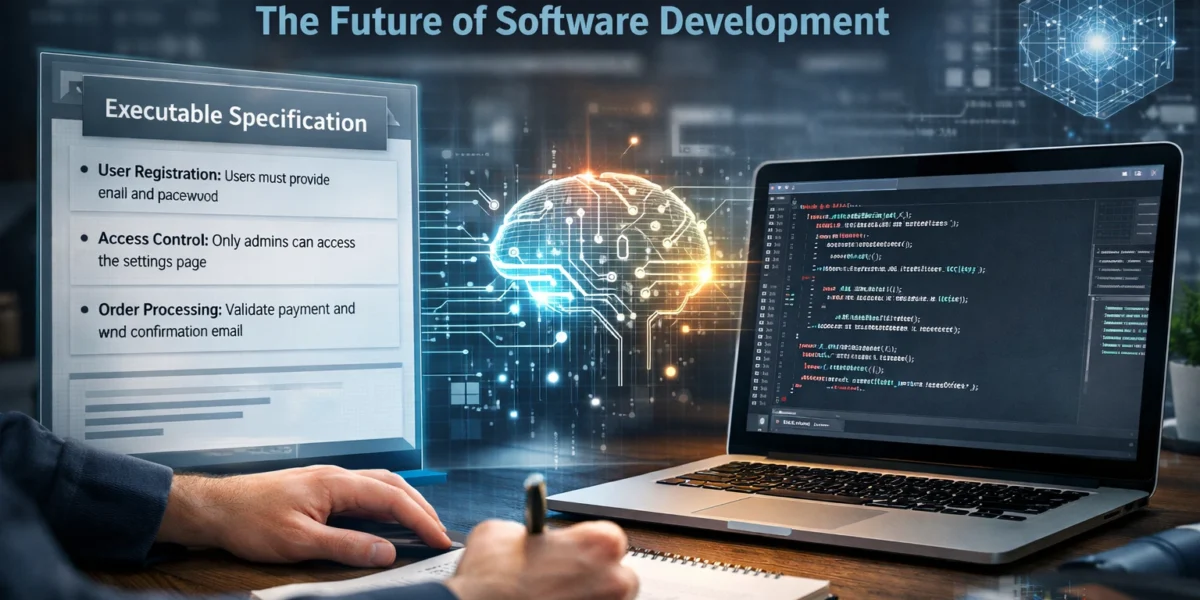
Now, we are entering the era of Executable Specifications, where the “source of truth” is the requirement itself.
The Evolution: From Documentation to Execution
The journey to this point has been driven by three massive shifts in tech:
- Advanced Natural Language Processing (NLP): Modern AI systems can now parse human intent with near-perfect technical accuracy.
- Domain-Specific Languages (DSLs): Tools that allow us to write in “Business English” while maintaining the strict logic of a compiler.
- Model-Driven Development: Creating abstract visual or textual models that automatically compile into production-ready backends.
The Role of AI in Bridging the Gap
Artificial Intelligence is the “compiler” for the modern spec. Tools like GitHub Copilot, Cursor, and the recently released Claude Code have proven that if a human can describe a feature accurately, the AI can realize it instantly.
Benefits of Treating Specs as Code
1. Massive Reduction in Development Cycles
By removing the manual “translation” step, teams move faster. Reflecting on Gartner’s 2020 prediction, the industry has now officially surpassed the 70% threshold for enterprise low-code adoption. Organizations utilizing specification-driven development report up to a 40% reduction in time-to-market.
2. The “Single Source of Truth”
In traditional dev, documentation is usually out of date the moment code is pushed. When the spec is the code, your documentation is always 100% accurate because the software literally cannot run without it.
3. Improved Accuracy and Consistency
Machines don’t “assume” what a business analyst meant. By forcing a level of precision in the specification, we eliminate the ambiguity that leads to 90% of logic bugs.
Real-World Applications and Tools
Several platforms are already leading the charge in 2026:
- Low-Code Powerhouses: Bubble and OutSystems allow complex logic to be built via declarative specs.
- Formal Specification: For mission-critical systems (aerospace, medical), languages like TLA+ ensure that the spec is mathematically perfect before a single line of traditional code is generated.
- AI-Native IDEs: Tools like Replit Agent allow users to build full-stack applications by simply refining their “Spec” in a chat interface.
Challenges: The Precision Paradox
Treating specs as code isn’t a “magic wand.” It introduces the Precision Paradox:
Writing a spec detailed enough to be executable is just as hard as writing the code itself.
It requires stakeholders to think with the same rigor as a programmer. You can’t just say “Make it secure”; you have to define exactly what security means in that context.
How to Get Started in 2026
- Start with “Spec-First” Logic: Use AI tools to generate boilerplate from your Jira tickets or Notion docs.
- Adopt Modular Specs: Don’t write one giant document. Write tiny, executable “micro-specs” for individual features.
- Invest in Training: Teach your product managers the basics of logic and structured data so their “specs” are machine-ready.
Conclusion: Embracing the Convergence
The future of software development isn’t about choosing between writing documentation or writing code—it’s about recognizing that they are two sides of the same coin. As AI becomes the ultimate interpreter, the person who can write the most “sufficiently detailed spec” becomes the most powerful developer in the room.
Are you ready to stop “coding” and start “specifying”?